KMU—S1 Say hi
Season One · final

50 episodes.

Don’t worship idols. Love people.

Arc IEpisodes 01–10Song: “Chosen” (Episode 1)

Chosen

The rule descends. Two lonely people recognize each other in stolen, unmetered minutes while the machine prices every other minute of Kai’s life. The audience falls in love with the people before the relationship.

01

Chosen

A stadium worships Kai in perfect unison, and nobody notices the too-small brand shoes or how much the smiling costs. At the fansign line, one fan asks the question the season will spend fifty episodes answering: “Can you say you’ll choose me?”

02

Touch-Up

Backstage, Miso becomes the first person who refuses to believe Kai’s “I’m fine.” The episode ends with MOM calling again, and Miso letting it ring.

03

First Look

The camera turns to Miso’s ordinary life: her mother Yuna was an idol in the nineties, and the apartment still runs on the wreckage of that career. Everyone needs her, and not one person asks how she is. At midnight she answers the one person who asked her for nothing: “I’m off Tuesday.”

04

Late Night Ramyun

Tuesday, hoods up, a corner-store window counter. His schedule allows eight minutes between gym and vocal lesson, and he takes forty. Mid-laugh, a flash goes off.

05

Extra Cup

Neither of them chases the photo; they go home separate ways, both failing to stop smiling. Miso detours to a basement studio where an engineer named Neko reads her heart by ramyun flavor and a calico named Yuumi claims her lap like rent. Across town, Kai’s thumb stops mid-scroll: his own hooded silhouette, already being shared.

06

Trending

The den in daylight: half a braid, half a mix, Miso laughing easier than she has all season. Then the photo lands in the feed between them and the laughter stops mid-breath. Neko asks the question nobody at work is allowed to ask, and Miso’s phone answers first: it’s Kai.

07

Nobody

He’s spiraling; she isn’t. She hands him the shield herself, “It’s nobody. Just staff,” and in the interview he says it a little too well. The season’s wound gets its name a full arc early, in a lie she helped write.

08

The Ledger

Another idol is caught dating, and protest trucks circle a building on the news. The Manager, not cruel, walks Kai through the weather report of albums, fansign lottery entries and emotional access, and lands on the truth: “It’s not that you can’t love anyone. It’s that it doesn’t sell.” And Kai’s own schedule turns out to be for sale in an open chat, priced like weather.

09

Full Coverage

The comeback machine at full volume, and a single Kai didn’t write, “You don’t look at me the same,” pouring off the playback. Miso pins the stage piece to his jacket, detached and flawless, painting over everything the last two episodes did to them. Take after take, he lip-syncs a stranger’s accusation at the one person it’s true of.

10

House Lights

Match cut: his eyes open on a bare face, no cameras, the set struck around him like a tide gone out. He finds the only unscheduled name in his phone, types “hey, are you okay?”, then deletes it one character at a time. Then footsteps: Miso crosses the work lights and sits down at the piano.

Arc IIEpisodes 11–20Music: Miso’s ballad (Ep 11) · “I Visit Yesterday” (Ep 17)

I Visit Yesterday

The hinge. A song overheard, a pin lost, and then the machine’s founder falls. In the space between a privacy window and a hospital hallway, every heart in the season changes lanes.

11

Encore

She thinks the house is empty; that’s the only reason it happens. Work coat still on, Miso plays “Chosen” as a ballad no setlist has ever held, and Kai, hidden between the seat rows, hears his own song mean something for the first time in his life. The last chord is still hanging when his phone rings at full volume.

12

The Pin

Spotlight physics save him and damn him: she can’t see past the glare, so her “Hello?” goes unanswered while the most famous face in the country commando-crawls toward the exit. The pin she fastened to his jacket catches a chair and stays behind. Miso picks it up and closes her hand around exactly who was listening.

13

The Privacy Window

The Chairman has had a stroke, and everyone asks what happens to the company; Miso slips out to ask what happens to the man. Kai offers his car before she can refuse, and the privacy window rolls up on their first unmetered minutes since the corner store. Then, quietly, he hums four notes, her four notes, and says it plainly: “You have a beautiful voice.”

14

The Long Way

He evens the ledger with a secret of his own: he misses writing songs. She answers with the thing she has never once volunteered, her mother’s name, and he hands the truth back: “Don’t shy away from that gift. I did.” Then the hospital rises through the windshield, wearing a wall of paparazzi.

15

Gia

An underground entrance, an intensive-care hallway, and a condition nobody will finish saying: unstable. Then heels, fast and expensive, echoing down the corridor: a glamorous woman with pink hair, crying as she walks. The antagonist of the season enters not at a podium but in a hospital basement, human first.

16

Only You

Gia breaks, and Kai does what Kai does: he holds the person who is falling apart. When the nurse allows one visitor and Gia reaches for his sleeve, Miso answers before the sentence exists, stepping backward, giving away her seat the way she’s given away everything: “Only you.” The door closes, and she is alone in a hallway holding flowers for a man she’ll never get to give them to.

17

I Visit Yesterday

2 a.m., wilted flowers, and a text that ends with a driver instead of a person. Miso leaves the flowers with the nurse and takes the subway instead, one small boundary, the first thing all night she’s chosen for herself. Then the machine finds her anyway: Kai’s face on the train-door screens, and a breakup song the whole country can hum, suddenly about her.

18

Unsent

Kai typed one word at 2 a.m., and the screen swallowed it with an incoming call: GIA. By morning she is the media-trained interim CEO reassuring shareholders, then walking offstage straight into his waiting car: “I don’t know who else I can go to.” Across town, Miso watches the typing bubble appear, then die, and puts her phone face-down.

19

Cash Out

Home is an apartment Kai shares with Noa and Soul, where a documentary about idols of the past glows on the TV, and there, radiant in archival footage, is a young Yuna. Noa cracks jokes about how they’ll all be washed up someday. Soul, working through a plate he built like a fortress, says the quiet true thing: “This industry is a casino. You make your money and you cash out.”

20

Candles

Yuna, older now, blows out birthday candles while Miso’s phone buzzes, and her mother, being her mother, smells it instantly. Drunk and suddenly loud, she delivers the family rule like a curse, and the biggest mistake of her life gets a name: Nobu. Miso, very evenly: “Wow. Thanks, Mom.”

Arc IIIEpisodes 21–30Music: “Complicated” is born (Eps 24–25)

Complicated

The good part, which is how you know what the season is about to cost. For eight episodes two people write a song. Then one employee’s camera roll ends it.

21

Lavender

Outside the restaurant, in the cold, Miso lights the thing she never lights in front of anyone: one lavender cigarette. Her one vice, her one unshared minute. Only then does she open the message that’s been burning in her pocket all night, and makes a call the episode refuses to explain.

22

Ten Minutes

The door opens and it isn’t Kai. It’s Neko, with counsel before courage: is she overthinking it, and why would he even like her, when he has the whole country and so obviously had a thing with Gia? By the time the phone leaves her hand with “yeah, I’m free,” Kai is already calling.

23

Just a Good Friend

Kai, in bed, can’t sleep: “What are you up to?” Between Neko’s whispered commentary and Miso’s careful questions, the real answers land easy as breathing: “I was worried about you. She’s just someone from the past. A good friend.” Miso decides to feel better, and then, realizing where she is: “We should write a song together.”

24

The Piano Store

A piano store full of cats, owned by Neko’s friend, where nobody recognizes a hooded Kai and Miso wears the biggest smile of the season. They try the song on, R&B, a love song, something happy-go-lucky, while Neko rejects sounds the only way she knows how: “That note lacks depth.” Miso cuts through all of it with the only question that matters: “How do we want people to feel?”

25

The Word

Two people answer at the same moment with the same word: “Complicated.” The afternoon becomes the thing songs are made of, her chords, his melody, a bench that keeps getting smaller, until GIA lights up the phone on the piano lid and Kai flips it face-down without breaking the melody. Miso sees, says nothing, and the song keeps earning its title.

26

Rooftop

A piano ballad carries the montage: car rides, boba, borrowed pianos, two people falling and calling it collaboration, while Noa and Soul say nothing loudly from across every room. In parallel, Gia runs an empire from a hospital hallway and checks her phone in elevators. At midnight it lands on a ramyun bar run entirely by robots, a rooftop, the whole city glittering, one human hour stolen off the top of the machine.

27

The Dotted Line

An employee leaks a photo: his hand moving a strand of her hair, tenderness photographed at the wrong shutter speed. Miso doesn’t pick up, and the brothers hold Kai steady with the oldest truth they own: “Remember the contract. No-dating rule. We’re not normal people.” Her phone rings out in a chair outside Gia’s office, where she sits very straight, alone, waiting to be seen.

28

The Watch

“Don’t take it personally. This is business.” Then, instead of a lecture, an heirloom: her great-grandfather’s watch, immaculate because every part does exactly what it’s meant to do, and this company is like the watch. No raised voice, no threat, and then Gia reads an incoming name upside down and smiles like a winner: it’s Kai.

29

Speaking of the Devil

Gia holds Miso’s eyes and picks up: “Hi Kai. I’m in a meeting right now, can I call you back?” Intimacy, demonstrated like a mechanism. Miso walks out in perfect form past twelve missed calls, three from Kai, nine from Mom, reaches the makeup room, her one room, closes the door, and breaks down.

30

The Allergy Card

The statement squashes the story, and the Tuesday call sheet does the rest: Kai’s chair now belongs to the Junior Assistant, and Miso is “rotated,” which is a word companies use for never. So she gives him the only thing she has left: she trains her replacement. Taped inside the kit lid, a hand-written card of his allergies: “He’ll never tell you when something hurts. That’s your job now.”

Arc IVEpisodes 31–40Song: “Dangerous” (Episode 38)

Dangerous

The slow burn and the price of it. The internet finds Yuna, then her daughter, and the season walks its cruelest staircase: the bullying, the mistake, the four-minute save, and a firing nobody in the room wants.

31

Retail Therapy

Gia’s world after hours: a private showroom that opens for one customer, no prices anywhere, because prices are for people who have to ask. Kai, cut off from the one person he wants to call, does what he has always done with feelings he can’t spend: he spends money instead. In the third boutique he laughs for real, catches himself, reaches for his phone to tell Miso, and buys something else instead.

32

Her Mother’s Daughter

The documentary clip escapes, a fan account does the bloodline math, and the internet finally has a face to chew on. Her mother’s scandal is re-litigated by children, and her station at work is rearranged by hands that want her to know they can. On the fire escape, lavender smoke curling, Miso answers her lit-up phone for once: “Mom. Don’t read the comments. Promise me.”

33

I’m Fine

Miso comes home stone-faced with convenience-store ramyun for two and says the sentence she has built a life on. For one night Yuna refuses to believe it: she sits her daughter at the vanity, wipes the day off her face with unexpectedly steady hands, and starts over from bare skin, the only makeover in the series where nobody is being prepared for anyone. In the mirror she says what she’s never been sober enough to say: “They came for me once. I won’t let them have you.”

34

Four Minutes

A live sponsor stage, twenty minutes to air, and a nineteen-year-old alone at Kai’s chair with a renamed formulation and a card that says the old name. His skin answers in minutes, and the terrified Junior Assistant does the only brave thing left: she texts the person she was given instead of the person she was given to replace. Four minutes later, antihistamine from her own kit and color theory over the flare, he goes on air flawless while a staffer in the doorway films the whole thing.

35

The Clip

One video, two readings. Online it plays as violation and the bullying finds a new gear, while inside, the old guard sets a printout in front of the interim CEO like a verdict: “Your building. Your discipline.” Alone, Gia watches it twice, once as a CEO seeing a liability, once as a person seeing the best hands she’s ever seen save her label’s biggest asset in four minutes flat, then closes the laptop while the invite goes out anyway: “Re: personnel.”

36

Still Immaculate

Gia does it herself, in person, the only mercy the building has left, with severance beyond generous and one honest sentence paid at full price: “You’re the only person in this building who does the job for the right reason. That’s why I can’t keep you.” Miso bows, perfect form, dry-eyed, because she spent her tears at twenty-nine and doesn’t perform twice. The revolving door turns, the air has gone winter, and neither she nor the building looks back.

37

Protection

Kai finds out the way artists find out everything, last and from a schedule change, and detonates in Gia’s office, the first time in his life he’s raised his voice at someone who signs things. She lets him burn all the way down, then shows him the board math quietly, like a doctor, and the terrible thing is that it’s half true. Two people who just lost the same person end up holding each other, and days later, in a private elevator with no cameras by design, the secret begins.

38

Dangerous

Weeks inside the secret, told in objects: a keycard to a private floor, dinners that never see a street, relief on tap that opens easier every day. Then at 3 a.m., at her white piano, Kai’s hands start telling the truth his mouth has been renting out: “Dangerous,” not a love song but a confession about a door, warmth that owns, comfort that costs. In the morning Gia listens to eight bars from the doorway, understands exactly what she is and isn’t to him, and, raised to hold assets, says: “Finish it.”

39

Nobu’s Tapes

Severance limbo: Miso sleeps until noon and hates it, reorganizes the den until Neko physically sits on her. Then Yuna opens the drawer for real: a shoebox of letters in Japanese and bad Korean, photographs of a bassist with kind eyes and terrible hair, and cassettes of unfinished songs, her father mid-idea, laughing between takes. “Your father never fit their machine either. That’s not the same as failing.”

40

The Best Hands

A conference room with better light and worse coffee: the rival label slides her own firing across the table and reframes it in one sentence. “Your old company saw a scandal. We saw the best hands in the business save a broadcast in four minutes.” Full creative control, her name on the work, a rebrand nobody else will touch, and a rough demo unfinished in exactly the same key as her father’s tapes; Miso says yes before she reaches the photo page, and then she reaches the photo page: RAIN.

Arc VEpisodes 41–50Songs: “Wait” (46) · “Someone Else” (47) · “Chosen (Reprise)” (50)

Wait

Winter, and everyone tells the truth in the only language they have left: songs. It all converges on the year-end awards in the snow. One stage, two songs, three hearts, and a country that has no idea what it’s actually watching.

41

Rain

Late to his own rebrand meeting, boots on the console, a guitar he won’t put down even indoors: the ex-frontman of a J-rock band that ended badly, with a burned bridge where a discography should be. He’s met a hundred image people and treats Miso like the hundred-and-first, until she watches him play one take, wild and unquantized and alive, everything Kai is never allowed to be for even four bars. “I’m not going to fix that. I’m going to build you a face that can survive it,” she says, and he looks at her properly for the first time.

42

It Got Complicated

The backstory arrives sideways, the way real ones do: the old band had a female lead singer, they were good together on stage and bad for each other off it, and he shrugs, sets down a guitar case: “it got complicated. So I left.” The word lands on Miso’s face and stays there a second too long, and he clocks it and doesn’t ask. The rebrand locks, rock bones dressed in shadow, velvet over gravel: two people building a mask together, each seeing the other’s real face for free.

43

Complicated

The secret breaks the way secrets break now: a dispatch photo, Kai and Gia, and a label statement that doesn’t deny it, so Miso learns from a screen, like everyone else. She goes to the den without ramyun, and the bridge the song was missing arrives in one take, because it isn’t craft anymore, it’s dictation. She sings it through once, knowing the country will never hear it, which is exactly the point, while Neko locks the drive as sole keeper and Yuumi climbs into her lap and simply stays.

44

Platinum

“Dangerous” drops and does what true things do when they’re produced this well: number one before the weekend, while Gia hears her own biography with the serial numbers filed off and pours the champagne anyway. Kai performs it flawlessly, buys a car he’ll never drive, the vice keeping pace with the emptiness, until the rival label’s teaser crosses his feed with a credit line that stops his scrolling thumb dead: CREATIVE DIRECTOR, MISO. He watches it four times, saves it, and buys nothing for the rest of the night, which is how we know it’s serious.

45

War Paint

The reveal shoot: the first artist face Miso has painted since Kai’s. Rain sits with the discipline of a man who has decided to trust exactly one person in the industry, and does the thing no chair of hers has ever done: he asks about her. That night the teaser lands and the industry gasps on schedule, and in the studio afterward Rain hums something new and slow, watching her the way you watch weather you hope will stay.

46

Wait

He plays it for her in an empty studio with no preamble and no eye contact, the way brave people are cowards. “Wait” is the healthiest sentence the show ever sings, love with no invoice and patience with no timer, and he never says who it’s for, because the room is very small and there are only two people in it. “It’s good,” she says finally, which they both hear correctly as not yet, and Rain nods like a man who has read the weather and packed accordingly: “It’ll keep.”

47

Someone Else

The awards lineup crosses Kai’s phone in the penthouse, RAIN, special stage, creative direction MISO, and he understands, with the precision of a man who once heard her sing in an empty theater, exactly what he is feeling and exactly what he has no right to feel. He goes where he always goes when the truth gets loud, the old practice room and the secondhand keyboard, and writes “Someone Else” in one take, wrong notes kept. Then he does something unprecedented, which is nothing: no upload, no producer text, just the first thing he has ever made that is not for sale.

48

Her Own Face

Awards eve, and the season’s first snow starts falling like the show ordered it. For the first time in the entire series, Miso becomes her own fairy godmother, her own hair, her own face, her own time, and when she stands, she looks like a K-pop star. The last touch is small: the pin, from the kit lid to her lapel, catching the light exactly the way secrets don’t.

49

The Winter Show

The whole season files into one snowbound building: Higher Heaven on the carpet, Gia arriving separately for the owner’s box, Neko and Yuumi home with noodles, and Bora, the fan from Episode 1’s fansign line, in the crowd with a handmade sign. The lights drop on the debut everyone has been teased into wanting: RAIN, velvet over gravel, no choreography, singing “Wait” to a country that thinks it’s a comeback and one woman side-stage who knows it’s a letter. In the wings, Kai catches the stage manager: “The encore. I want to change it.”

50

Chosen (Reprise)

The arena goes dark, and instead of the production number the country was promised, one piano rolls out into the snow-quiet. Kai, alone, unstyled, mic barely necessary, plays “Chosen” the way a woman once played it in an empty theater when she thought no one could hear. The country holds its breath at their idol being suddenly, dangerously human. Gia, in the owner’s box, hears the difference between the man she has and the man singing. Yuna, home in front of the TV, holds a photo of her daughter and cries at a song that isn’t about her, which is its own kind of healing. And mid-verse, Kai finds Miso side-stage in the dark, her own face, her own coat, and sees, glinting at her lapel, a small piece of a stage jacket he lost in an empty theater a lifetime ago. He doesn’t stop playing. He sings the rest to one person, in code, in public, and the whole country sings along to a love letter addressed to someone whose name they will never know. No kiss. The doors open. Everyone walks out into falling snow, and it feels, impossibly, warm. Then the sting, final ten seconds: a backstage corridor, Rain and Kai passing in opposite directions. Rain, without slowing: “She has a beautiful voice, doesn’t she?” Kai stops walking. Cut to black. SEASON TWO.
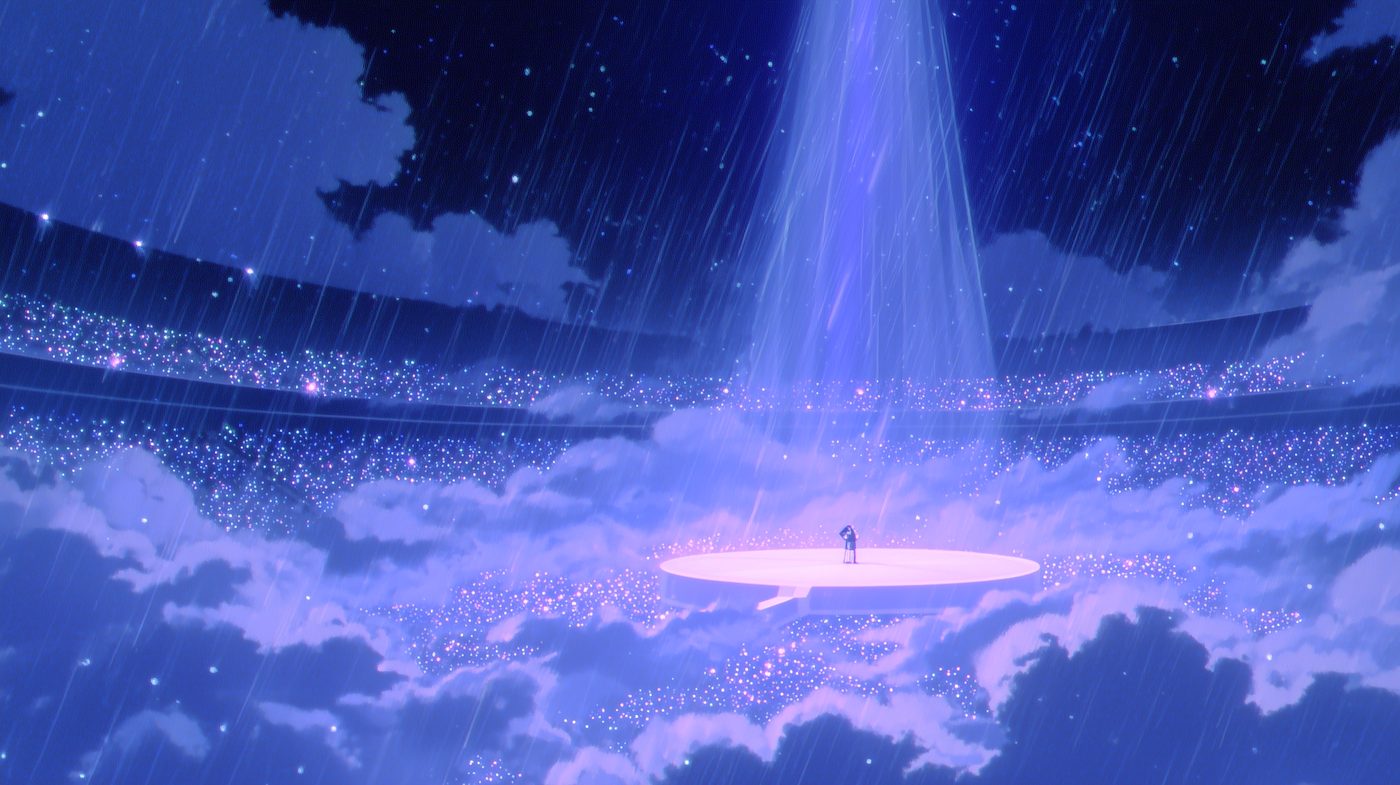
Don’t worship idols. Love people.

The story